Productivity and firm size in construction, pt2
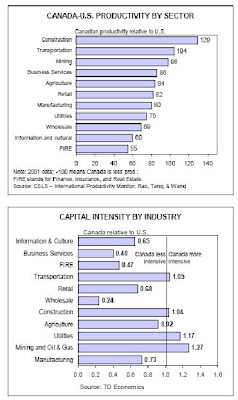
A couple of posts back I asked why Canada’s construction sector is said to be more productive than the U.S. sector, despite having smaller establishment sizes. The gap isn’t huge, but it’s surprising. I don’t know if any single concept can answer this. Instead, I’ve broken it down to two questions: why are the Canadian firms small, and why are they more productive.
On being small…
Small establishments are unburdened from taxes on inventory
If one considers the high taxes that the construction sector faces on inventory, it seems reasonable that large companies wish to unburden themselves of this tax by contracting individuals to do certain services. Perhaps in Canada self employed contractors are more willing to take on the risk of being taxed on inventory (perhaps due to favourable tax scheme on Canada’s self employed, in comparison to the U.S.? I don’t know if this would justify the gap).
If one considers the high taxes that the construction sector faces on inventory, it seems reasonable that large companies wish to unburden themselves of this tax by contracting individuals to do certain services. Perhaps in Canada self employed contractors are more willing to take on the risk of being taxed on inventory (perhaps due to favourable tax scheme on Canada’s self employed, in comparison to the U.S.? I don’t know if this would justify the gap).
Variable taxes, in contrast to flat taxes, keep establishments small, even in Canada’s most populated areas where construction productivity is destined to be highest regardless of establishment size
B.C. has the lowest provincial tax rate in Canada up to a taxable income of $67,500 per annum. Above this income level, the rate rises rapidly and Alberta becomes the lowest personal tax jurisdiction at an income of $88,000 per annum. B.C. has the highest unincorporated self employment rate of all of Canada in the construction sector while Alberta has the highest incorporated self employment rate (see graphics below that I created using StatsCan CANSIM data Table282-0011). Perhaps Canadians are more sensitive to an un-level tax scheme than Americans.
Here's my colour scheme: B.C. has the lowest provincial tax rate in Canada up to a taxable income of $67,500 per annum. Above this income level, the rate rises rapidly and Alberta becomes the lowest personal tax jurisdiction at an income of $88,000 per annum. B.C. has the highest unincorporated self employment rate of all of Canada in the construction sector while Alberta has the highest incorporated self employment rate (see graphics below that I created using StatsCan CANSIM data Table282-0011). Perhaps Canadians are more sensitive to an un-level tax scheme than Americans.
self employed unincorporated w/ no paid help,
self employed incorporated w/ paid help,
self employed incorporated w/ no paid help,
and the final pie in lime is self employed unincorporated with paid help.


On being more productive…
Economies of scale are relatively unimportant in the construction sector
Construction is highly labour-intensive, depends on a high proportion of low-skilled jobs and is not considered a high technology sector. Further, I would argue that where economies of scale do matter in the construction sector, they mean less than they once did. Thus, simply being big doesn’t give U.S. firms a greater advantage in this sector.
Construction is highly labour-intensive, depends on a high proportion of low-skilled jobs and is not considered a high technology sector. Further, I would argue that where economies of scale do matter in the construction sector, they mean less than they once did. Thus, simply being big doesn’t give U.S. firms a greater advantage in this sector.
And yet this isn’t the case with other labour intensive industries. The U.S./Canada "productivity gap is large in other labour intensive industries such as textiles and clothing as well as in fabricated metals, the machinery and computers industry, and the electronic and electrical equipment industry." So maybe this idea is a dud.
The hidden economy
If labour inputs are somehow being underestimated, then productivity (measured in my last post as GDP divided by hours worked, by the way) could be distorted.
If labour inputs are somehow being underestimated, then productivity (measured in my last post as GDP divided by hours worked, by the way) could be distorted.
For example, John O’Grady (2001) estimated that, on average, the annual underground income in Ontario’s construction industry, in the period 1998-2000 increased to $2.395 billion. This is due to the "hidden economy" composed of self-employed individuals who wish to conceal their income, which we know is easier to do in the construction sector than nearly any other sector.
Also, I think dachisb made a good point in response to my first post: "I would wager that low cost labour (read mexican migrants) drives most of this difference."
Not all construction is made equal
I’m not sure what affect this would have, but I thought it was worth noting that heavy and civil engineer construction is much smaller in Canada then, say, the construction of buildings. Surely many modes of construction have their own unique productivity level, and the compilation differs across countries.
I’m not sure what affect this would have, but I thought it was worth noting that heavy and civil engineer construction is much smaller in Canada then, say, the construction of buildings. Surely many modes of construction have their own unique productivity level, and the compilation differs across countries.
Am I missing anything? Any more ideas anyone?