Showing posts with label inflation targeting. Show all posts

Tuesday, November 28, 2006

The BoC's big obstacle

The Canadian press is giving a lot of ink to the possibility of the Bank of Canada setting a lower inflation rate in the future and, further, the possibility that it may favour price targeting. Of course, no action would happen until 2011 if it happened at all, but with the next renewal due this December, the subject is a popular one.
If the public doesn't "get it" though, is price targeting worth pursuing? From The Toronto Star:
Inflation target under review (Nov.27)
[UWO prof David Laidler] acknowledged it would be “risky” to change the rules without careful preparation of the public, but proposed a one per cent target, stressing that “a two per cent inflation rate is a far cry from anyone’s (or at least any retiree’s) idea of price-level stability.”
The Bank of Canada raises another, more complex, possibility: targeting a price level. This would mean that periods of above-target inflation — which under the current policy are written off while the bank seeks merely to return to the two per cent level — would have to be offset by periods of inflation below the target to produce stable long-term prices. The bank’s document acknowledges “the difficulty that might be associated with explaining price-level targeting to the general public.”
Officials intend to complete their research “well before 2011 so as to ensure sufficient time for open discussion of the results and their implications.”

I'm beginning to think that one of the biggest obstacles associated with price targeting is the public's confusion over what it actually is and how it would work. Ben Bernanke and Allan S. Blinder could probably write a book or two on this subject by now after Bernanke proposed “the explicit numerical definition for the price stability objective” (I've blogged about the confusion they've both seen here). Bernanke's proposal is something like inflation targeting; still, I think his experience with proposing a new regime, as I wrote about in the link above, says a lot.

Monday, November 13, 2006

A new inflation target?

With the expiry of the inflation-control agreement held between the Bank of Canada and the Government of Canada arising this December, people are talking.

Some background from the BoC:

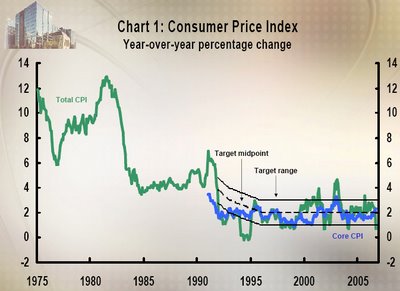
In February 1991, the Government and the Bank introduced targets aimed at reducing the rate of inflation. The objective was to achieve a 3 per cent inflation rate by the end of 1992 (the lowest inflation rate in almost two decades) and to gradually reduce the rate of inflation to 2 per cent by the end of 1995. The targets were extended twice—first from the end of 1995 to the end of 1998 and then from the end of 1998 to the end of 2001. Both extensions involved maintaining a target range of 1 to 3 per cent with a midpoint of 2 per cent.


Graph Source: Government of Canada

Pierre Fortin, an advocate of the theory of downward nominal-wage rigidity, says it should be raised to three per cent (Fortin, P. 2001. "Inflation Targeting: The Three Percent Solution." Policy Matters 2: no.l, Institute for Research on Public Policy). This is unlikely to happen though. The BoC maintains that “the argument for the effects of downward nominal-wage rigidity is not a persuasive one in deciding on an appropriate inflation target.”

David Laidler of UWO says the rate should be lowered to one per cent.

This is more likely. In fact, there's been some speculation that the BoC is considering a target of zero. I found this to be surprising. Two things interest me in particular: the probability of hitting a zero floor on interest rates, and the impact of deflation.
An excerpt from a 2001 BoC document:


The Zero Floor on Nominal Interest Rates

A number of authors have argued that the zero floor on nominal interest rates prevents real (that is, inflation-adjusted) interest rates from falling far enough when inflation is below its target, thus leading to a prolonged period in which the economy is weak and inflation remains below its target. After reviewing the evidence, including importantly Black, Coletti, and Monier (1998), and the papers in Fuhrer and Sniderman (2000), Bank economists Amirault and O'Reilly (2001) conclude that most researchers would estimate the probability of hitting the zero floor as negligible for an inflation target of 2 per cent. Moreover, although this probability rises at an increasing rate as inflation falls, their evaluation of the empirical literature is that there would be only a slight increase in the probability as one moved down to a 1 per cent inflation target. This latter conclusion is less widely held. Some authors are more cautious regarding the proposition that the probability increases only slightly, in contrast to Parkin (2001). As well, Parkin notes that the work of Reifschneider and Williams (2000) shows that explicitly taking into account (in various ways) the zero floor in the central bank's reaction function for setting interest rates significantly lowers the cost of hitting the zero bound in the unlikely event that it is hit.

Potential Risk of a Costly Deflation

Mishkin (1997, 2001) has emphasized the importance of avoiding deflations because of their cost. It is important to distinguish at the outset, however, between an unexpected price decline (of, say, one year in duration) and a persistent deflation. It is also necessary to note that there are costs whenever consumers, firms, and financial institutions are adversely surprised. An unexpected price decline of, say, 2 per cent with an inflation target of zero is no more costly than a temporary drop in the inflation rate to zero for a year with an inflation target and expected rate of inflation of 2 per cent. On the other hand, a deflation with some persistence will be more costly than a reduction in inflation of the same size if it causes problems to arise either from hitting the zero floor on nominal interest rates or from downward nominal-wage rigidity. For example, persistent deflation at 2 per cent per year when the inflation target is zero would be more costly than inflation persisting at zero when the inflation target is 2 per cent only to the extent that its persistence becomes more prolonged because of those two problems. But it is important to note that central bank targeting of a specific inflation rate provides a high level of protection against persistent deflation.
We conclude from this analysis that the serious problems come from persistent deflation, that they stem from the first two factors discussed in this document, and that they are unlikely to arise under explicit inflation targeting.

Friday, July 21, 2006

Explicit numerical definition for the price stability objective

Not long after I wrote my last blog entry on "numerical inflation targeting," I ran into the term again. The news article I read criticized numerical inflation targeting (IT) and implied, once again, that Ben Bernanke supports this policy. I felt faint. Have I missed something? Have I been bemoaning the ill use of a phrase when it's actually a loose term that everyone but me knows not to take literally? Bullocks. I'm no prude.

Well, here's a telling excerpt from a speech given by Allan S. Blinder (Feb 2006):

This nomenclature issue is particularly important to the Federal Reserve because of its dual mandate to promote both “stable prices” and “maximum employment.” That may be why Ben Bernanke, while a Fed governor, decided not only to drop the IT name, but to state categorically that “what I am suggesting is not equivalent to inflation targeting.” That was a wise decision on his part. In the U.S. context, the term “inflation targeting” is a political and public relations burden and is therefore best dispensed with.

So, there you have it. The man even has a distaste for the term “inflation targeting.” So, my complaint isn't for nothing. Right? Well, now consider what Laurence Meyer had to say at the same event:

Janet Yellen takes a similar position. [She said,] “I, for one, am not a strict inflation targeter…and—as far as policy-makers go—I do not think I am in a minority. A natural next step for the FOMC is to announce an explicit numerical longrun inflation objective.”
Here again, the distinction is drawn between “inflation targeting” and announcing a definition of price stability.... It is therefore not surprising that the FOMC, in the minutes of the July 2005 FOMC meeting, describes the debate as being about whether or not to provide an explicit “numerical definition for the price stability objective.” The minutes never mention the words “inflation targets” or “inflation targeting.” The bottom line is that if Bernanke is to move the Committee towards an explicit numerical definition of inflation, he will have to differentiate it from the IT.

To sum up. Words not to be used to describe Bernanke's “framework”:
1. Numerical inflation targeting; and,
2. Inflation targeting. period.
The correct term: “explicit numerical definition for the price stability objective.”

No wonder supporters of a “price-targeting path” don't want to use Bernanke's terminology. The terminology itself would at first glance make their argument seem pithy to those who are confused about Bernanke's proposal (and I think it's safe to assume that most people are).
And finally, why the use of the term “explicit?” Is this misleading if Bernanke's proposal is to be a “flexible framework” where a path of targets are continuously revised (or at least reviewed) and dependent on the careful monitoring of economic indicators?
Meyer says,“The Fed...has the most explicit implicit inflation target in the history of central banking.” Does Bernanke advocate an “explicit implicit” target? I'm beginning to not care. It seems to me that a unique policy approach is being suffocated by terminology we find cozy.
From this post forward, the “explicit numerical definition for the price stability objective” will be
referred to as “Bernanke's proposed policy.” Which, by the way, is actually not “Bernanke's policy” - it was originally proposed by Meyer in 2001.
Are we sick yet?
There are some good discussions on Bernanke's proposal here. (link to Bank of Canada)

Thursday, July 20, 2006

'Frameworks': The lost paper by Ben Bernanke

Unless Bernanke's views have changed since he co-wrote “Inflation Targeting: A New Framework for Monetary Policy?” (Bernanke and Mishkin, 1997), he does not advocate numerical inflation-targeting for the US economy; however, I've noticed that the policy is often mistakenly attributed to him. Bernanke has expressed his views on inflation targeting as a flexible "framework, rather than a rule." I believe this approach is quite different from setting a numerical target, or even a fixed target range. He has expressed that when inflation targeting is viewed as a flexible framework, the “target” can and should be frequently re-evaluated to meet the needs of an economy by careful and regular monitoring of a variety of indicators.

From Bernanke and Mishkin's paper, here is an example of a flexible inflation targeting framework in action -- a demonstration of how flexible inflation targeting 'can adjust to accommodate supply shocks or other exogenous changes in the inflation rate outside the central bank's control':

[Consider] Deutsche Bundesbank's practice of stating its short-term (one-year) inflation projection as the level of “unavoidable inflation.” In the aftermath of the 1979 oil shock, for example, the Bundesbank announced the “unavoidable” inflation rate to be 4 percent, then moved its target gradually down to 2 percent over a six-year period. In other cases, the central bank or government makes explicit an “escape clause,” which permits the inflation target to be suspended or modified in the face of certain adverse economic developments.

Further, another often overlooked fact is that countries that practice inflation targeting often hold exceptions or caveats (eg. imports and short-run fluctuations in energy prices in Switzerland; indirect taxes, food and energy in Canada; mortgage interest, government controlled prices and energy in Australia). (Pierre Siklos, Money, Banking, and Financial Institutions: 2004, p.467)

To be fair, perhaps the term “numerical inflation targeting” is often used loosely. Perhaps others don't see the merit in making a distinction.

On July 13, John Taylor had this to say in the Washington Post (excerpt via Greg Mankiw's blog):

Some have argued that the lesson learned from this recent volatility experience is that the Fed should set a specific numerical target for inflation. I disagree; recent experience indicates setting such a target could increase volatility again. First, we do not know what inflation rate to target. If we choose one, we might have to change it later. Second, an explicit focus on the inflation rate may actually take emphasis away from price stability. Focusing on a numerical inflation rate tends to let bygones be bygones when there is a rise in the price level. In recent research, Yuriy Gorodnichenko and Matthew Shapiro of the University of Michigan found that Mr. Greenspan placed relatively greater weight on the price level than on the inflation rate in speeches: He was twice as likely to mention the price level as inflation; Mr. Bernanke was half as likely to mention the price level as inflation.

In sum, powerful lessons can be learned from Mr. Bernanke's start. Keep to the proven principles. Talk about the economy, not about the future of the federal funds rate. Commit to price stability without adding uncertainty about the meaning of a new inflation target.


Taylor's article expresses criticism against numerical inflation targeting, not the flexible framework discussed by Bernanke.

Bernanke and Mishkin's paper is worth reading and can be found here.